Every founder has experienced this: you find a system that worked for another business, implement it faithfully, and six months later you’re managing more chaos than before. You hired the team member everyone recommended. You bought the project management tool with the best reviews. You launched the process your consultant suggested.
And none of it stuck.
This isn’t a failure of effort. It’s a failure of sequence. Implementation without a clear foundation almost always creates more complexity instead of less — because you’re adding structure on top of a system you don’t fully understand yet.
Motion is not the same as progress
When businesses grow, leaders feel pressure to move. Investors want results. Clients want responsiveness. Teams want direction. That pressure creates urgency — and urgency often leads to implementation before understanding.
You add tools to improve communication before diagnosing why communication was breaking down. You hire for capacity before identifying whether unclear ownership was creating duplicate work. You design new processes before seeing how existing ones actually flow.
The result is a business that’s moving fast in multiple directions — which is exhausting, expensive, and often not progress at all.
What a clear foundation actually looks like
Building from a clear foundation doesn’t mean slowing down indefinitely. It means pausing long enough to see what’s true before deciding what to build.
A clear foundation includes three things:
First, visibility into how work flows. Not how you think it flows — how it actually moves through the business day to day. Where decisions happen, where they stall, and who’s absorbing the pressure when things don’t go to plan.
Second, an honest picture of where effort is concentrated. Many operational breakdowns look like capacity problems from the outside but are actually design problems underneath. When ownership is unclear, people compensate with more effort. When handoffs are fuzzy, individuals fill the gaps. When decision paths aren’t defined, founders become the default answer to everything.
Third, a grounded understanding of what your team actually needs to succeed. Not what you think they need — what they’re telling you through their behavior, their questions, and the patterns that keep repeating.
Why leaders skip this step
Diagnosis feels slow. In a business that’s moving, taking time to understand before building can feel counterintuitive — even irresponsible.
But the cost of skipping it is significant. Leaders who implement without a clear foundation tend to cycle through the same fixes at higher stakes: more hires, more tools, more processes — each time hoping this one will finally address what’s not working.
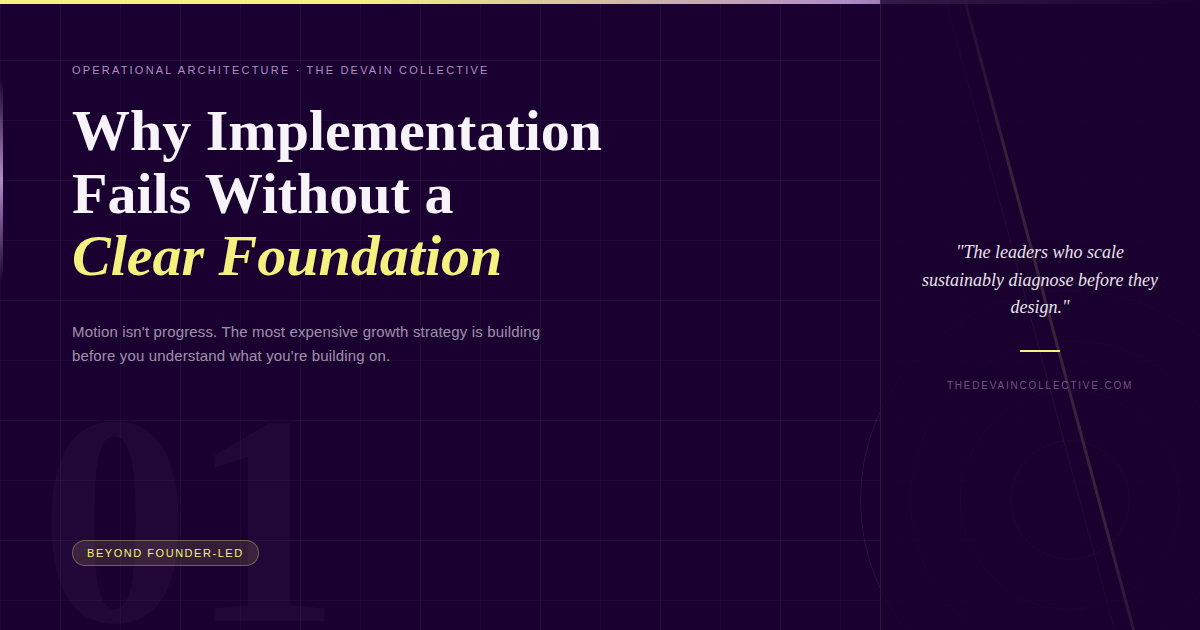
The businesses that scale sustainably tend to share one habit: they diagnose before they design. They resist the pull of urgency long enough to see the whole picture. And then, when they do build, what they create actually fits.
What changes when you build from clarity
When leaders understand their business before they implement solutions, several things shift.
Investments become targeted. Instead of adding tools or headcount across the board, you know exactly where structure will reduce pressure — and where it won’t.
Teams experience less friction. Clarity about ownership, expectations, and decision paths means people spend less energy navigating ambiguity. Work becomes more sustainable.
Problems surface at the right level. When systems are designed from real understanding, issues don’t have to escalate to the founder. Teams can address friction where it occurs, learn from it, and adjust.
And perhaps most importantly — progress becomes visible. When you’ve built from clarity, you can see what’s working. Refinement becomes intentional instead of reactive.
The leaders who scale sustainably tend to share one habit: they diagnose before they design.
Start with understanding
If you’re feeling the weight of implementation that isn’t landing the way you hoped, it’s worth asking: what do I actually know about how this business operates right now?
Not what you assumed when you designed the solution. Not what it looked like on paper. What’s actually true — about how work flows, where friction lives, and what your team needs to do their best work.
That understanding is the foundation everything else gets built on. Without it, you’re guessing — and guessing is the most expensive growth strategy available.
If you’re ready to stop implementing from assumption and start building from clarity, the Strategic Discovery Audit is designed exactly for that. It gives leaders complete visibility into how their business actually operates — so every next step is grounded in reality, not guesswork.