Speed is celebrated in business. Move fast. Ship early. Iterate quickly. There’s real wisdom in those principles — they’ve helped founders launch, test, and adapt in ways that slower-moving organizations can’t.
But there’s a version of speed that creates a problem most founders don’t see until they’re already in it. When fast becomes the default — when every decision, hire, and system is built at a sprint — the business eventually catches up with itself.
Suddenly the tools aren’t talking to each other. The team isn’t sure who owns what. The processes that worked at ten clients are breaking at thirty. The founder is still the answer to everything, just more tired than before.
This isn’t a failure of speed. It’s a failure to distinguish between building fast and building well.
What building fast actually produces
Building fast gets you to market. It gets you to revenue. It gets you to the next milestone.
It also produces a kind of organizational debt — the accumulated weight of decisions made under pressure, systems designed for yesterday’s complexity, and processes that were good enough when the business was smaller but are now creating friction at scale.
Most leaders don’t notice this debt accumulating in real time. It shows up gradually: in the meetings that are becoming less productive, the team members who are quietly overwhelmed, the decisions that keep landing on the founder’s desk instead of being made at the right level.
By the time it’s obvious, the debt is significant — and it costs more to address than it would have cost to build thoughtfully the first time.
What building well actually requires
Building well doesn’t mean building slowly. It means making choices about what kind of foundation you’re creating — and whether it can actually carry the weight of the growth you’re planning.
It starts with understanding before implementation. Before designing a system, a leader who builds well asks: what do I actually know about how this part of the business operates? Where does work stall? What’s creating unnecessary friction? What does my team need to execute confidently?
It continues with designing for people, not just efficiency. The systems that last aren’t the ones optimized for speed in isolation — they’re the ones built around how people actually work. Realistic capacity. Natural communication patterns. Decision-making authority that matches actual context.
And it requires willingness to design the next right version rather than the final version. Building well isn’t about perfection. It’s about clarity. When ownership is defined, priorities are visible, and decision paths are known, the business can move without the founder being the answer to everything.
The leaders who scale without burning out
There’s a pattern among leaders who grow sustainably. They’re not the ones who work the hardest or move the fastest. They’re the ones who’ve learned to pause before implementing — to understand what’s actually happening before deciding what to build.
They trade short-term urgency for long-term traction. They build architecture that can carry growth instead of architecture that creates more work as growth arrives.
Six months later, the difference is stark. Both founders are operating at similar revenue levels — but one is managing increasing chaos while the other is leading a business that can carry its own complexity.
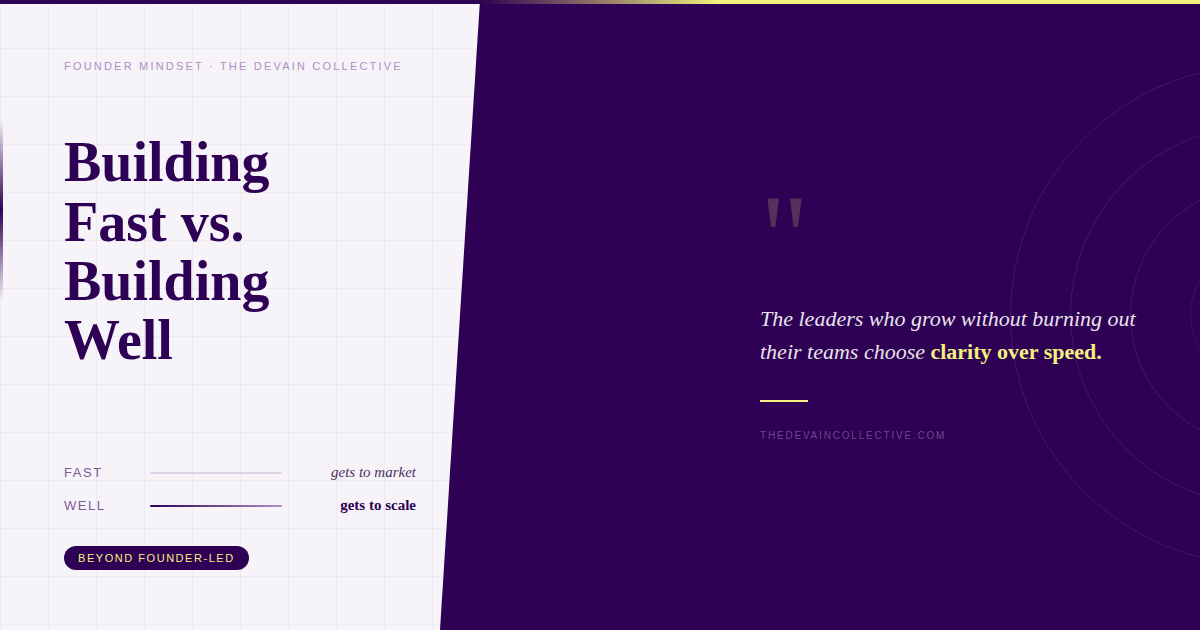
Building fast gets you to market. Building well gets you to sustainable scale.
A question worth sitting with
If you’re honest about how your business was built over the last twelve months — how many of those decisions were made from clarity versus urgency?
How many systems were designed after understanding the problem versus implemented in response to immediate pressure?
How many hires were made from a clear picture of what was needed versus a reactive response to what was breaking?
There’s no judgment in those questions. Most founders are building under pressure with incomplete information. But at some point — especially in the $500K to $5M range — the costs of building fast without building well start to compound.
That’s the moment for a different kind of investment: not in another tool, another hire, or another process — but in understanding. In seeing what’s actually happening inside the business before deciding what to build next.
That’s the foundation that makes everything else work.