For a long time, I thought culture was a language problem.
If I could just find the right words — the phrases that captured what I wanted the business to feel like, the values that named what I cared about, the language that translated my instincts into something a team could absorb — then culture would follow. Words first. Behavior later.
It did not work. Not for my clients, and not — when I was honest — for me.
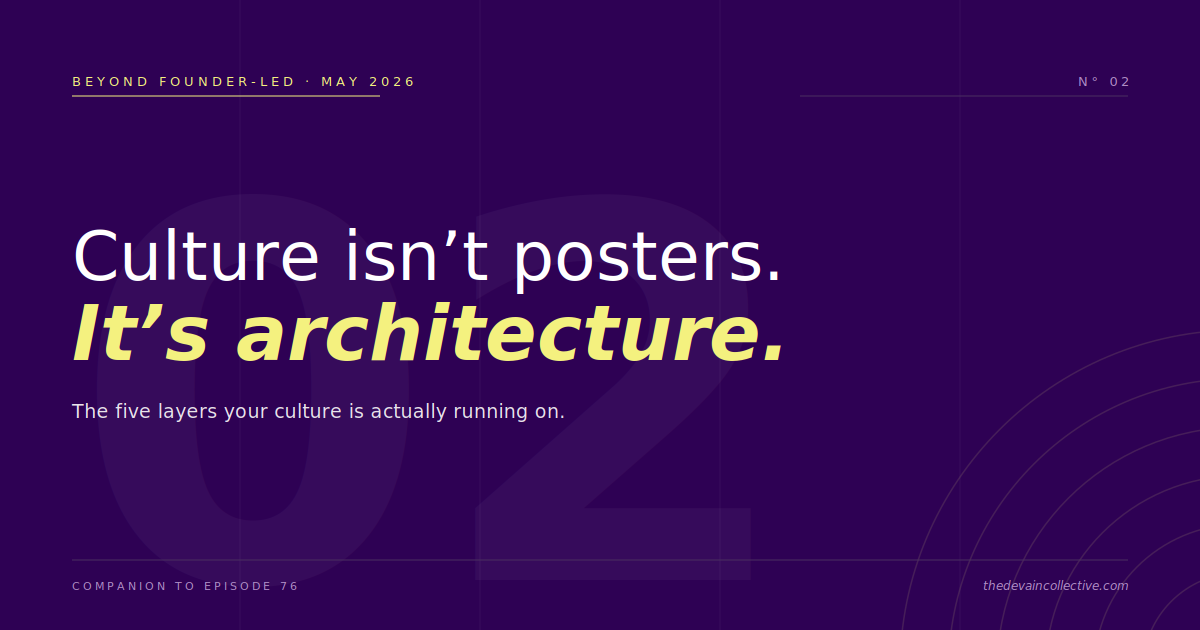
What actually worked was a different frame entirely. Culture is not a language problem. It is an architecture problem. And the five layers of that architecture are the thing you actually have to design.
WHY LANGUAGE CANNOT CARRY CULTURE ALONE
Values statements describe the culture you want. They do not produce it.
The reason is simple. Your team’s daily experience of your business is not shaped by what you say. It is shaped by how work actually happens — the meetings that run, the decisions that get made, the information they have or do not have, the rituals that mark the week, and the defaults that fill in every moment no one is making an active choice.
All of that is architecture. Not posters. Not language. Architecture.
Your team’s daily experience of your business is not shaped by what you say. It is shaped by how work actually happens.
And the good news about architecture is that you can see it. You can map it. You can redesign it one layer at a time — without having to overhaul the whole business, without launching a culture initiative, without asking anyone to memorize a new set of values.
THE FIVE LAYERS YOUR CULTURE IS ACTUALLY RUNNING ON
Every service-based business runs on five architectural layers. Your culture is the emergent shape of how those five layers fit together. Change one, and the shape changes.
Layer 1 — Meetings
Who is in the room. How often they are in the room. What authority they hold when they are in the room.
Meetings are the most visible piece of your architecture. They tell your team who matters, what matters, and how decisions get made. A weekly team meeting where the founder makes every call sends a completely different cultural signal than a weekly team meeting where the team makes calls and the founder listens. Same meeting. Opposite culture.
If you want to understand your culture, watch your meetings. Count who talks. Count who decides. Count who is silent.
Layer 2 — Decision rights
Who decides what. At what level. By when.
This is the layer founders most often skip, and it is almost always the one carrying the most cultural weight. Unclear decision rights create a culture of permission-seeking. Every question routes to the founder. Every judgment call waits for her input. The team learns to bring her everything — not because they lack skill, but because the architecture never told them where their authority ends and hers begins.
Clear decision rights, in writing, with explicit criteria, change the culture faster than any values exercise ever will.
Layer 3 — Information flow
Who knows what. How they found out. What they can act on with the information they have. Information flow is quiet, which is why it is easy to miss. But it shapes behavior every day. When information lives only in the founder’s head, the team has to ask. When information is stored in a system the team can access, they can act. Same people, same mission, completely different cultural experience.
If your team asks you the same three questions every week, those questions are not a people problem. They are an information flow problem.
Layer 4 — Rituals
The recurring moments that carry meaning.
Rituals are the smallest, most overlooked layer — and often the most powerful. The way a week opens. The way a project closes. The way feedback happens. The way wins get acknowledged. The way hard conversations get held.
These moments, repeated, create the texture of your culture. They are what your team remembers when they describe working with you. A weekly reflection ritual tells a different story than no reflection ritual. A project closeout ritual tells a different story than silently moving to the next thing.
You do not need many rituals. You need a few good ones, practiced consistently.
Layer 5 — Defaults
What happens when no one makes a decision.
This is the layer I find myself coming back to most often, because it shapes behavior in every moment you are not looking. When a project ships late, does the team default to working more hours or to renegotiating scope? When a client is unhappy, does the team default to escalating to you or to solving it in their own lane? When someone new joins, does the team default to giving them a written onboarding path or to letting them shadow you and figure it out?
Defaults are invisible until you name them. Once you name them, you can design them.
Defaults run your culture twenty-four hours a day, whether you are in the room or not.
HOW TO FIGURE OUT WHICH LAYER TO REDESIGN FIRST
You do not redesign all five layers at once. You pick the one where the redesign would have the highest leverage — the one carrying the most current dysfunction.
A fast diagnostic. Ask yourself each of these questions, and notice which one makes you most uncomfortable:
- Do my meetings actually move work forward, or do they exist because I need information to make decisions?
- Can each of my team members tell me — without checking — which decisions are theirs to make and which are mine?
- If I went offline for two weeks, would my team have the information they need to keep working?
- Do we have any rituals that consistently mark important moments, or does the week just flow by?
- When something goes wrong and I am not available, what does my team default to doing?
The question you flinched at is your layer. That is where the redesign lives.
ONE LAYER AT A TIME
The temptation, especially for founders who are pattern-matchers by nature, is to redesign all five layers at once. Resist it.
Pick the one layer where the redesign will have the highest impact. Spend thirty to sixty days building the new structure. Watch what changes — not just in outcomes, but in how your team moves through the day. Then pick the next layer.
This is how architecture gets built. Layer by layer. Intentionally. With space between each one to let the change settle.
It is also, as it happens, how culture actually shifts. Not with a values overhaul. Not with a language refresh. With patient, structural redesign of the systems that carry the behavior.
THE BROADER FRAME
Last week we named the gap between what you say you value and what you actually reward. This week we are answering the next question — how do you redesign the business so the two come back into alignment.
The answer is not language. The answer is architecture. Five layers. One at a time. On purpose.
Next week, we take this frame into summer — specifically, into the architectural work that needs to happen in May if you want your business to hold its shape in June, July, and August without you being the glue that keeps it together.
Because summer is not a slow season. It is a diagnostic one. And the diagnosis it offers is always about architecture.
Ready to move from diagnosis to design?
If this piece gave you language for something you have been feeling, the next step is the Strategic Discovery Audit — the diagnostic that maps your current architecture, identifies the highest-leverage redesign, and gives you a prioritized roadmap.
No guessing. No generic advice. Diagnosis before prescription — every time.
Book your Audit at thedevaincollective.com